The last academic year ended in April 2006. This issue combines events that occured in March through April 2006.
Academy of Teacher Excellence News
Students started conducting group sessions this month in KLC. It was a different experience for all the children and they all
cooperated with great enthusiasm.
The current batch of students presented their case studies on autism and mental retardation to an open audience. The presentations
included narratives of first-hand experiences in working with children with disabilities.
Kaleidoscope Learning Center (KLC) News
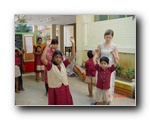
The term-end saw a flurry of activities in KLC. As the temperature soared, KLC decided to cool themselves with Water Day!
Children, teachers and plants, all splashed, poured and got thoroughly wet. Lots of enjoyment and lots of coolness!
KLC parents were delighted to receive their children’s report, which was a portfolio of their class photograph, their
achievements and the record of their progress.
New admissions were finalized and KLC is packed for the summer. Teachers dusted, cleaned and sorted their classes, which are
all set for the new term.
Gudny Jonsdottir, who worked in our school as part of the AIESEC exchange programme was given a farewell on the 1st of March
as her term came to an end. Gudny’s inputs for us in the area of communication have been very valuable and have been incorporated
in the children’s programme.
The Yoga programme conducted by the Krishnamacharya Yoga Mandiram-Mitra continued, with the children being divided into
2 ability groups.
V-Excel Remedial Center (VRC) News
The teachers and the therapists have been in the process of mapping out the current performance levels for all the children.
It’s that time of the year when there is active stocktaking and introspection for making the Individualized Educational Plan for
each child for the new academic year.
Dr. Vasudha Prakash met with the parents of all the remedial children in April '06. The parents shared their concerns in the
open forum and some of the issues that were addressed relate to:
Speech development & Language processing
Parental training
Support for siblings
Family training
Writing
Sensory needs
Communication & Socialization
Aggression
School environment and ideal placement for the kids
All the teachers and therapists got together in March to further deepen their understanding of the way the children
learn and express. Five teachers shared their observations and inferences with the group, leading to an intense discussion
and interesting inferences.
Those children in inclusive schools had been reviewed and assessed in their current environment. Most of them have done well
and have been promoted to the next grade.
Bridges Learning Academy
NIOS children were in the heat of intensive exam preparation.
Revision classes were conducted for the primary and middle levels.
The teachers were busy with question paper preparation and year-end assessments.
Other News
As part of ‘Project Classmate’, a joint effort by ITC Ltd. and V-Excel Educational Trust, playmaterials and furniture
worth Rs. 1,000,000 were distributed in 16 schools in Karamadai and Mettupalayam districts of Coimbatore.
Nine resource rooms at Villipuram block are effectively functional under Sarva Shiksha Abhiyan. The government has sanctioned
additional funds to the resource rooms for necessary purchases.
It was fun, fun, and more fun on March 3rd, when the entire staff of V-Excel set off on an annual picnic. Sterling Resorts,
Mahabalipuram played host to nearly 40 of us, and the spirit sure did give the other guests a complex. Be it the enlivened
dance-floor that unmasked the covert dancers in the group, the dash in the beach (thanks to Neha Bhalla who spared none from a
splash), the sporty sessions of cricket, badminton and volleyball, the post-lunch recreation of indoor-sports and pottery,
or the soothing foot-massage, it was a well-deserved welcome break.
Contact Info :: India:
V-Excel Educational Trust
#1 Norton 2nd Street
Mandaveli Chennai 600 028
Tel: 91 - 44 - 24620243
91 - 44 – 24956373 E-mail us or visit us at www.v-excel.org
Contact Info :: USA:
Academic Concepts, Inc.
1403 Merrywood Drive
Edison, NJ 08817
Tel: (732) 572-3748
Tax ID: 22-3632715 E-mail us
Volunteer Info:
Volunteers are an integral part of our success. Our most pressing needs are in the areas of occupational and speech therapies, and
as teacher aides. We also require assistance in library management.
If you have any of these and are interested in volunteering at V-Excel, please contact us.
Sensory Integration
* What is sensory integration? Sensory experiences include touch, movement, body awareness, sight,
sound, and the pull of gravity. The process of the brain organizing and interpreting this information is called sensory integration.
Sensory integration provides a crucial foundation for later, more complex learning and behavior.
* What are some signs of Sensory Integrative Dysfunction? : A child with sensory integrative
dysfunction: is overly sensitive and under-reactive to touch, movement, sights, or sounds;
is easily distracted; has social and/or emotional problems; has an activity level that is unusually high or unusually low; is
physically clumsy or apparently careless; is impulsive, and lacking in self control; has difficulty making transitions from one
situation to another; is unable to unwind or calm self; has delays in speech, language, or motor skills and in academic achievement.
* What steps can be taken? : An evaluation can be conducted by a qualified occupational or physical
therapist. Evaluation usually consists of both standardized testing and structured observations of responses to sensory stimulation,
posture, balance, coordination and eye movements. If therapy is recommended, the child will be guided through activities that
challenge his ability to respond appropriately to sensory input by making a successful, organized response. The motivation of the
child plays a crucial role in the selection of the activities.